The Credential Mirage:
Why Certificates Don’t Always Reflect Real Skills
In today’s digital era, online certifications have become extremely popular. Students often collect multiple badges believing they reflect expertise. However, a certificate only shows that a course was completed—it does not prove the ability to apply concepts in real-world situations.
True skill is demonstrated through action: solving unexpected problems, adapting to changing requirements, and handling real-time challenges. These experiences cannot be learned through quizzes or theoretical modules alone.
Where Certificates Fall Short:
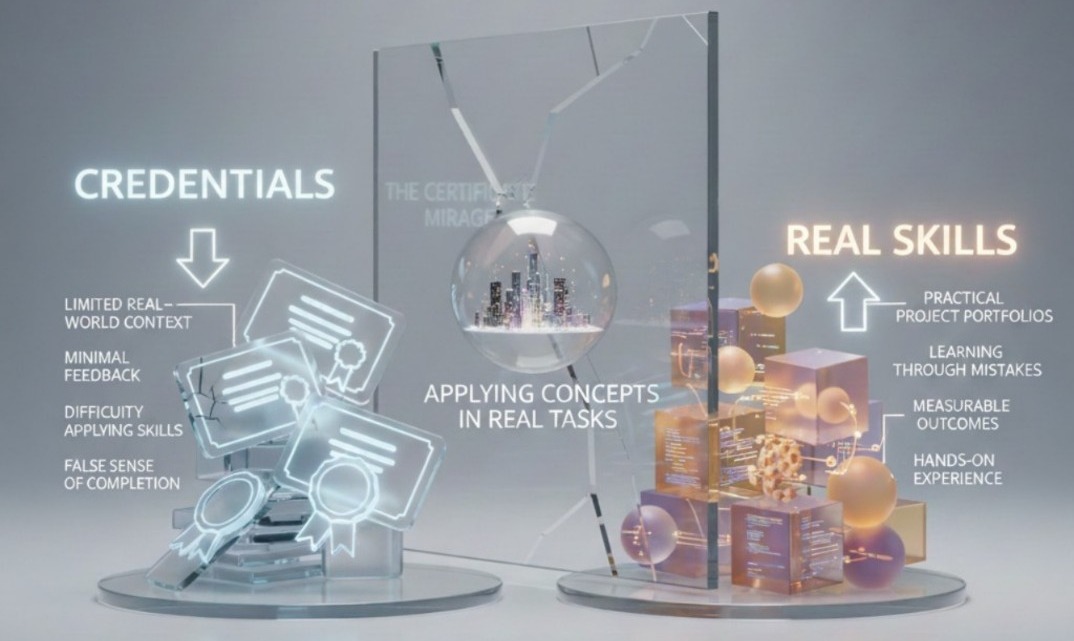
1. Limited Real-World Context: Courses use ideal examples, while actual projects involve unclear data, technical constraints, and unpredictable challenges.
2. Minimal Feedback: Online assessments rarely evaluate thought process or mistakes, which are essential for growth.
3. Difficulty Applying Skills: Knowledge learned in isolation may not transfer easily to diverse teams or fast-paced environments.
4. False Sense of Completion: A certificate can create the illusion that learning is finished, when real mastery requires ongoing practice.
This reflects a common reality among students today. The Internet is filled with courses that offer quick certifications, some even priced as low as ₹500. While these may seem appealing, the real value of a course does not lie in the certificate itself but in the skills it helps you build.
A degree may take three years, but without exposure to industry practices, tools, and problem-solving methods, the learning often remains theoretical. Adding a certificate that lacks depth or practical application does little to change this.
The essence of meaningful learning can be summarized in the line:
“You tell me, I will forget. You teach me, I will give results.” What Really Builds Competence:
1. Creating practical project portfolios: Demonstrates real capability by showcasing work that solves actual problems, not just theoretical understanding.
2. Applying course concepts in real tasks: Turns learned concepts into usable skills by implementing them in real-world scenarios.
3. Learning through mistakes and feedback: Builds depth and resilience by refining skills through iteration, errors, and constructive feedback.
4. Focusing on measurable outcomes instead of accumulating certificates: Prioritizes tangible results and impact over passive credential collection.
Conclusion
Certificates can open doors, but they do not guarantee capability. Real growth comes from hands-on experience, consistent practice, and the ability to deliver results. Ultimately, it is your work-not your credentials-that defines your professional value.
____________________________________________________________________________________________________
About The Author :
Harsh Jha | LinkedIn Passionate about content writing, digital marketing, and website development. Harsh builds engaging digital learning experiences that empower students and professionals to gain practical, industry-ready skills. His focus is on ensuring learners not only earn certificates but also develop real-world skills, knowledge, and confidence to succeed in their careers.
